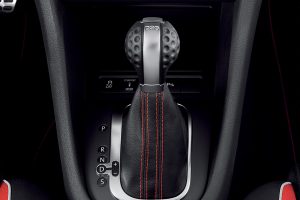
DSG, short for Direct-Shift Gearbox (German: Direkt-Schalt-Getriebe), is a dual-clutch automatic gearbox developed by the Volkswagen Group. In Audi models it is usually called S-Tronic, while in Volkswagen, Škoda and Seat models it is commonly known as DSG. It was first introduced in 2003 in the Volkswagen Golf R32 and later became widely used across the VAG model range.
The key design feature of DSG is that it combines two gearboxes and two clutches in a single unit. This allows extremely fast gear changes. One clutch controls the odd gears and reverse, while the other clutch controls the even gears. In practical terms, the gearbox can pre-select the next gear before the shift happens, which makes the change very quick.
DSG gearboxes are fast: an average gear change takes around 200 milliseconds. This is slower than the fastest racing transmissions, but significantly faster than a conventional hydraulic automatic gearbox with a torque converter. Manufacturers have sometimes quoted even lower theoretical shift times, although real-world shift behavior depends heavily on software strategy, clutch control, torque request and driving conditions.
Because of its design, DSG played a significant role in making automatic transmissions popular in Europe. Today, automatic and dual-clutch gearboxes dominate many passenger car segments where manual transmissions were once standard.
A lesser-known fact is that the first dual-clutch concept was used in Porsche racing applications, including the Porsche 962 in the 1980s.
The DSG gearbox is a complex mechanism. It has clear advantages over traditional manual and hydraulic automatic gearboxes, but it also has its own characteristic behaviour and weak points. We will not go too deeply into mechanical construction here, as there is a large amount of useful information available online, mostly in English and German. Instead, we will focus on the software side — the part we can optimize.
In modern vehicles, almost every important component is controlled by electronic control units. The more complex the component, the more complex its software control. DSG gearboxes are a perfect example.
Not every software map inside a gearbox control unit is critical, and not every map is changed during engine or gearbox software modification. However, when increasing or reducing engine power, the following DSG / S-Tronic calibration areas are often relevant:
In theory, the software of a DSG gearbox is designed to adapt to changing mechanical conditions. Gearbox oil temperature, coolant temperature, clutch wear, heating and cooling cycles, solenoid behaviour, valves, sensors and mechatronic components all change over time. The factory software is designed to tolerate a certain amount of wear and deviation from new-condition behaviour.
Unfortunately, factory software does not always solve everything. Software updates for engine and transmission control units may correct some issues discovered after production, but other calibration imperfections or possible improvements may never be revisited. Manufacturers have limited engineering time, and not every drivability issue becomes a priority.
DQ200 (0AM, 0CW) is used with many Volkswagen Group <2.0 liter engines from 2007 onwards.
DQ200 is the first and only 7-speed DSG gearbox from this manufacturer with a dry clutch. Compared with the earlier DQ250, this gearbox has more potential weak points and several well-known factory design limitations. The most common issue is premature clutch wear. In many cases, clutch life and drivability can be improved by correcting the original DQ200 gearbox control software.
Other known DQ200 issues and symptoms:
What can we offer for DQ200 gearbox software?
Additional possible improvements, priced individually:
Typical situations:
Inefficient gear selection strategy. When driving through a long bend or a roundabout, the DSG may select the wrong gear. The result is poor acceleration response. In many cases this happens because the gearbox-selected gear does not match the engine’s boost and torque behavior properly.
Delay during acceleration and gear selection. When driving calmly and then suddenly asking for acceleration, the vehicle may react slowly and with delay. If the accelerator is pressed harder, the car may suddenly jump forward. This can often be improved: both engine and gearbox response can be made more logical and predictable.
Driving at excessively low RPM. DSG may select a high gear at very low engine speed. During calm driving below 60 km/h, the gearbox may already be in 7th gear while the engine runs at around 1000–1200 rpm. When the accelerator is pressed gently, the engine and gearbox may produce audible and noticeable vibration. Over time, these symptoms may become more pronounced and may contribute to premature flywheel wear.
This situation is corrected by changing the shift strategy and avoiding excessive upshift-downshift cycling. At the same time, clutch and gearbox service life can be improved.
Sport mode (S). Many drivers admit that driving in S mode is not always pleasant. Even during calm driving, upshifts may happen too late and downshifts too early. The engine becomes unnecessarily noisy and inefficient in terms of fuel consumption. Galingas LT software optimization allows S mode to be used more effectively in city driving and, where required, can be adapted for towing a trailer or caravan.
Shuddering. If you feel shuddering when moving away from very low speed, or during the 1st to 2nd gear change, the situation can go two ways: the gearbox or clutch may already require repair or replacement, or the issue may be improved by software correction, delaying mechanical repair.
DQ250 (02E, 0D9) is a very popular transmission used in many Volkswagen Group vehicles, mainly with 2.0 TDI, 2.0 TFSI / TSI and 3.6 FSI engines. It has been in use since 2003 and, with gradual improvements, remained one of the most successful DSG units. It is generally considered a reliable and well-engineered gearbox.
With modified software, this gearbox is capable of handling up to approximately 600 hp and 650 Nm of torque, depending on mechanical condition and clutch setup. The newest version of the DQ250 gearbox received the DQ260 designation from around 2018.
Known DQ250 issues and symptoms:
What can we offer for DQ250 gearbox software?
Typical situations:
Inefficient gear selection strategy. When driving through a long bend or roundabout, DSG may select the wrong gear. The result is weak acceleration response. This is often caused by a mismatch between selected gear, engine boost behavior and torque availability.
Acceleration delay and gear selection delay. When driving calmly and then suddenly accelerating, the car may react slowly. Press the accelerator harder and the vehicle suddenly surges forward. This can often be improved by making the engine and gearbox respond faster and more predictably.
Driving at excessively low RPM. DSG may select a high gear too early. During calm driving below 60 km/h, the gearbox may already be in a high gear while the engine runs at around 1000–1200 rpm. A gentle accelerator input may cause vibration from the engine and gearbox. Over time this may become worse and may contribute to flywheel damage. Correcting shift strategy can reduce unnecessary up-down shifting and improve clutch and gearbox life.
Sport mode (S). Many drivers find factory S mode unpleasant in normal driving: upshifts happen too late, downshifts too early, the engine is noisy and fuel efficiency suffers. Galingas LT DSG software modification allows S mode to work more logically in city driving and can also be adapted for towing.
Shuddering. If shuddering is felt when moving away from low speed, or during the 1st to 2nd gear change, the issue may be mechanical wear or a software-related control problem. In some cases software optimization can improve the situation and delay repair.
Maximum RPM on TDI engines. Under full acceleration, DSG often shifts close to the rev limiter, around 4500–4700 rpm depending on software version. We usually recommend an earlier shift point, around 3700–4000 rpm. This allows the car to accelerate faster by using the effective torque range more efficiently, while reducing unnecessary stress on the engine and turbocharger.
DQ380 / DQ381 (0DE, 0GC) gearboxes are used in Volkswagen Golf GTI and Golf R models from around 2017 onwards. They are also found in selected Audi S3 models for the Chinese market from 2016.
Known DQ380 / DQ381 issues and symptoms:
What can we offer for DQ380 / DQ381 gearbox software?
Typical situations:
Inefficient gear selection strategy. When driving through a long bend or roundabout, DSG may choose the wrong gear, resulting in weak acceleration response. This is often caused by gearbox software that is not ideally matched to the specific engine behavior. Software correction can improve this.
Driving at excessively low RPM. DSG may select higher gears at very low engine speed. During calm driving below 60 km/h, the gearbox may already be in 7th gear while the engine runs at around 1000–1200 rpm. A gentle throttle input may cause audible and noticeable vibration. Over time this can become worse and may damage the flywheel. Correcting shift strategy helps avoid excessive up-down shifting and can improve clutch and gearbox life.
Sport mode (S). Many drivers find factory S mode poorly matched to their expectations. Downshifts may happen too early or sometimes too late. Modified S-mode software can adapt gear selection to the desired driving behavior and the actual engine characteristics.
DQ500 (0BH, 0BT) is essentially a stronger and more capable development of the DQ250 gearbox. It is commonly used in Volkswagen Transporter-based vehicles due to its higher torque capacity. It is also found in Audi TT RS, Audi RS3, VW Tiguan in Europe, Audi Q3, Seat Alhambra with stronger engines and several other models.
In simple terms, DQ500 is larger and stronger than DQ250. For this reason it is a popular upgrade in high-power vehicles such as Volkswagen Golf VII R, Golf VII GTI, Audi S3 and similar platforms.
Known DQ500 issues and symptoms:
What can we offer for DQ500 gearbox software?
DL501 (0B5) is used exclusively in Audi vehicles under the S-Tronic name. It is found in models such as A4, A5, A6, A7 and Q5 with Quattro all-wheel drive, combined with engines such as 2.0 TSI / TFSI, 2.0 TDI, 3.0 TFSI, 3.0 TDI, S4, S5 and selected RS applications.
In 2013, DL501 was updated and became known as DL501-G2, or generation 2.
DL501 is one of the strongest S-Tronic / DSG-type gearboxes. The manufacturer officially rates it at 600 Nm, but in real use it can often handle around 620–650 Nm without software changes, and up to around 1000 Nm with serious software intervention and upgraded clutch components.
What can we offer for DL501 S-Tronic software?
The mechanical part of DL501 and other DSG / S-Tronic gearboxes is generally reliable and rarely fails without a clear reason. However, more serious faults in the mechatronic unit — the gearbox control and hydraulic/electromechanical control assembly — cannot always be solved by software. In such cases, repair or replacement is required.
Mechatronic repairs for DSG / S-Tronic gearboxes can be performed using precise laser-welding technology and other repair methods intended to improve the service life of key mechatronic components compared with some factory solutions. One of the specialized repair providers in Lithuania is TMT Service in Kaunas: www.tmt.lt


