FAQ
Frequently Asked Questions
Answers about ECU remapping, diagnostics, gearbox programming, fuel economy, reliability, warranty and technical inspections.
The short answer: professional ECU remapping, done sensibly and on a technically healthy vehicle, should not damage the engine.
Most horror stories come from two very common sources: poor-quality work by inexperienced tuners and vehicles that already have hidden technical problems.
In many markets, a car with “220,000 km” on the odometer may in reality have a much more complicated history. That means the owner must understand the condition of the vehicle before asking for more power. A worn clutch, weak turbocharger, tired injectors, poor DPF condition or unstable fuel pressure will not become healthier just because the ECU file is modified.
We are often asked to inspect or correct work done elsewhere. The most common mistakes in poor ECU calibrations are:
- Incorrect boost pressure targets, which may be dangerous for the turbocharger
- Incorrect fuel pressure or injection quantity, which may harm the high-pressure pump, injectors and emissions systems
- Incorrect torque limiters, which may overload the clutch, flywheel, gearbox and driveline
For a reliable and sensible power increase, the main conditions are:
- A technically healthy and properly maintained vehicle
- Experienced specialists who understand both diagnostics and ECU calibration
- A calibration that is not made unnecessarily aggressive
- Responsible use of the vehicle and proper maintenance after tuning
We appreciate clients who are genuinely interested in cars, diagnostics and technology. When you leave the vehicle with us, we are happy to answer relevant questions and discuss the work in a clear and respectful way.
However, our working procedure is simple: we exchange the necessary information, the client leaves the vehicle with us, and we do the work without distractions so that it can be completed properly and on time.
We do not allow clients to stand next to us and observe the work in detail. There are several reasons for this:
- safety
- confidential information on work computers
- working methods and professional know-how
- focus on the vehicle and the task, not on conversation and curiosity
Have you ever compared the same film in 4K quality and on an old VHS tape? The story may be “the same”, but the quality is not.
At first glance, it may seem that everyone is simply “uploading a file”. In reality, the difference between professional calibration work and generic tuning files is enormous.
We create or adapt engine management software according to the specific vehicle, its technical condition and the customer’s requirements. We do not use universal files, unknown files from the internet, or risky solutions without proper diagnostic analysis.
Many cheaper services are quick solutions: little or no proper diagnostics, limited responsibility and files intended for “everyone” and “no one in particular”. Sometimes they work. Sometimes they do not. In the worst case, they may damage the ECU, DPF, clutch, turbocharger or fuel system.
We do not work with that kind of compromise. Our price reflects knowledge, equipment, experience, diagnostics and responsibility for the result. If price is the only criterion, someone will always promise to do “the same thing” cheaper and faster.
The answer is almost the same as in the previous question.
After more than 20 years in this narrow field, we have learned to focus on quality, result and reliability. Proper diagnostics, safe reading/writing procedures, file preparation, testing and verification take time.
A one-hour promise usually means that something important is being skipped.
Yes.
We can arrange ECU unlocking for programming on selected modern control units, including:
BMW / Mini:
https://galingas.lt/naujienos/bmw-ecu-dme-atrakinimas-md1-mg1-programavimui/
Ford
Mercedes-Benz:
https://galingas.lt/naujienos/mercedes-ecu-md1-mg1-atrakinimas-programavimui/
The exact procedure depends on the ECU type, software version and vehicle model.
Excellent question — especially nowadays, when many people buy a Bluetooth adapter and suddenly consider themselves diagnostic experts.
The term “computer diagnostics” is often understood very differently. For many people it means reading fault codes, translating them into plain language and deleting them “so they do not disturb”. Professional diagnostics is something else entirely.
Computer diagnostics means working with a large amount of live data: testing important parameters under the correct conditions, saving the data, analysing it and drawing conclusions.
Consumer-level tools such as OBD11, Carista or ELM327-type adapters are useful for basic checks, but they usually communicate only with the main ECU and a limited number of control units. They use simpler universal PIDs, and access to data is often limited by the tool, protocol or licence.
Professional diagnostics means access to all relevant control units, manufacturer-level fault information, high-refresh live data, actuator tests, adaptations and firmware analysis. We can also check CAN communication load, module communication errors and hidden faults that amateur tools may never show.
Before programming a vehicle, we need a complete overview of its technical condition. Even a small anomaly — for example, a weakly reacting sensor or a hidden fault in another subsystem — may affect the final result. We rely only on what we can measure, evaluate and document ourselves.
Every programming solution we apply is based on tested methods, real-world behaviour and the specific engine type. We are technically careful and we know exactly what we are changing.
If you notice objective changes after programming, we are always ready to check them and help. However, if the concern is mostly theoretical, or if the goal is to search for the smallest possible doubt without a real technical reason, we honestly suggest choosing another service provider.
We respect everyone’s time and believe in constructive cooperation.
In the past, we kept a list of programmed vehicles on this website. As the volume of work increased significantly, we stopped maintaining a full public list here.
You can find regularly updated examples of programmed cars, trucks and tractors here:
www.facebook.com/galingas.chip.tuning
Also on our Instagram account:
https://www.instagram.com/galingas.lt/
In normal conditions, yes.
Leaving aside poor-quality programming work, a technically healthy vehicle with a sensible power increase should pass technical inspection without problems.
If the vehicle is already in poor technical condition — for example, it smokes, has emissions problems or has been badly maintained — the problem should be searched for in the technical condition of the vehicle, not automatically in the ECU remap.
Technical inspection is intended to assess the general condition of the vehicle, safety systems and emissions control systems according to the applicable rules. Vehicle power is not measured during a standard technical inspection.
We perform only work that is directly related to engine management, diagnostics and drivetrain software: computer diagnostics, power increase or reduction, emissions system software corrections, selected automatic gearbox programming and engine power measurement on a high-accuracy 4×4 dynamometer.
We do not sell or manufacture visual tuning parts such as spoilers, grilles, wheels or window tinting film.
No.
We work with passenger cars, vans, trucks, tractors, combines and other heavy machinery. We also work with selected marine engines.
More information about our main service areas can be found in the upper sections of our website.
There is a popular saying: horsepower tells you how fast you hit the wall; torque tells you how far you move the wall. There is quite a lot of truth in that.
Short version. Torque is the “muscle” of the engine. It shows how much rotational force the engine can send through the drivetrain to the wheels.
The higher the torque, the stronger the vehicle pulls, especially at lower RPM. It is the feeling of being pushed into the seat when you press the accelerator.
Low-RPM pulling force = torque. High-RPM speed potential = horsepower.
Long version. When reading engine specifications, we usually see two main values: power and torque. They are related, but they are not the same thing.
Torque is the rotational force produced by the crankshaft. Power describes how quickly work is done. A high-torque engine can move a heavy load, but without enough power it may do it slowly. An engine with high power but low torque may be fast at higher RPM, but it will not feel strong when heavy work is required.
This is why heavy machinery and trucks have very high torque figures. A Volvo FH truck with a D16G engine may produce around 2650 Nm and 540 hp. The torque is necessary to move heavy loads. A sports car may have similar horsepower, but much lower torque because it has a completely different job to do.
Yes, of course.
For the software part of our work — the engine management calibration — we provide a warranty without a fixed time limit, provided that the file is not modified, copied, analysed or altered by anyone else after our work.
Warranty for the mechanical part of the vehicle can only be provided by the vehicle or component manufacturer.
For mechanical work performed by us, the warranty period is usually 12–24 months, depending on the type of work.
A modified engine or gearbox control program is considered an intellectual work product.
After the vehicle leaves our premises, a refund for completed programming work is not possible.
If the service was performed incorrectly, it is covered by our quality warranty.
If the service was performed correctly but the result does not meet the customer’s subjective expectations, the payment is not refundable. It is always possible to restore the original software, but the modified file itself can be copied, which is another reason why payment for programming work is not refundable.
VAG Group
We program VAG Group automatic gearboxes, including Volkswagen, Audi, Skoda and Seat DSG / S-Tronic / Tiptronic AL551 / AL552 and other transmissions, for purposes such as:
- increasing torque limiter values
- reducing shift time by up to 20%
- activating Launch Control where supported
- adjusting shift points and shift conditions
More information about DSG / S-Tronic gearbox issues and programming is available here:
https://galingas.lt/blogas/dsg-pavaru-dezes-ju-programavimas/
We also program selected VAG CVT and conventional hydraulic 8-speed automatic gearboxes, such as AL551 and AL552. The main goals are hydraulic behaviour correction, torque limit adjustment and selected gearbox operating conditions.
BMW
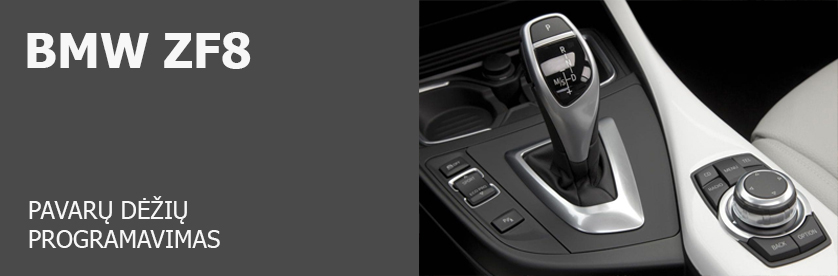
We also program popular BMW ZF6 / ZF8 automatic gearboxes:
- torque limiter correction
- faster gear changes
- gear-specific torque limiter correction for improved launch behaviour
BMW ZF 8HP automatic gearboxes are used in many BMW models produced since 2009, including:
BMW 1 Series, 2 Series, 3 Series, 4 Series, 5 Series, 6 Series, 7 Series, 8 Series, X1, X3, X4, X5, X6, X7 and Z4.
Mercedes-Benz
We work with selected Mercedes-Benz automatic gearboxes, including 7G-Tronic, 7G-Tronic+, 9G-Tronic, 7G-DCT and 8G-DCT.
FCA Group
Selected Fiat, Alfa Romeo, Lancia, Maserati, Chrysler, Dodge and Jeep gearbox software solutions are available depending on the gearbox and control unit type.
Porsche
Selected Porsche PDK, PDK2 and Tiptronic gearbox programming solutions are available.
For more detailed information about automatic gearbox programming, please contact us directly.
Manufacturers prefer to keep software control within their authorised networks, and independent calibrators are not always welcome in that ecosystem.
From the official manufacturer point of view, powertrain warranty — engine and gearbox — may be affected if power is increased outside the manufacturer’s own system or outside an authorised partner network. Some manufacturers work with official or semi-official partners, such as ABT, MTM, Polestar, BMW Performance and others.
A major development in recent years is the investment made by manufacturers into detecting non-factory software modifications.
Modern Bosch MD1 diesel ECUs and MG1 petrol ECUs may contain internal counters or stored data that can indicate changes to the original software integrity. Because of this, there is a real possibility that manufacturer warranty may be affected after non-factory tuning.
In short: with diesel engines, a sensible calibration can often reduce fuel consumption. In many cases the reduction is around 5–15%, depending on the vehicle, driving style and workload.
There is a separate term for this approach: eco tuning. The goal is to reduce fuel consumption while increasing torque in the efficient working RPM range. This is used not only for cars, but also for trucks, tractors and other machinery.
With petrol engines the situation is different. Due to engine design and operating principles, reducing fuel consumption while increasing power is often not realistic.
There are some exceptions:
- VAG TSI / TFSI petrol engines combined with DSG gearbox software optimisation
- VAG 1.0 TSI / TFSI engines that are strongly limited in torque from the factory
- selected large Porsche petrol engines
Stage 1 is a time-tested and sensible power increase based on the construction of the specific engine and drivetrain. The goal is to achieve the best balance between power, reliability and fuel economy. With normal use and a healthy vehicle, there should be no serious risk of significantly shortening engine life.
Stage 2 means noticeably stronger performance, but also higher load on the engine, clutch, gearbox and brakes. Power is increased more aggressively and, depending on the vehicle, minor hardware modifications may be required. The customer must understand the risk of earlier component wear depending on how the vehicle is used.
Stage 3 is a heavily modified calibration intended for aggressive power and torque increases. Significant mechanical modifications are required. The customer must understand that the risk of failures is considerably higher.
Unrealistic requests for Stage 2 or Stage 3 tuning often come from young drivers who have just bought their first car — usually a vehicle that is already 10–15 years old. In such cases we try to explain the risks clearly and help the customer avoid repair bills that may represent a significant part of the vehicle’s market value.
If we see that the customer understands the risk and the vehicle is technically healthy, we may perform a stronger-than-usual calibration.
We emphasise that we do not perform tuning above Stage 1 on vehicles that are still covered by manufacturer warranty.
We use a dynamometer for passenger cars when:
- the engine construction or software version requires measured verification
- there are questions about the technical condition of the vehicle
- the customer wants exact power and torque results
- the dyno measurement service is ordered separately
When working with heavy machinery — tractors, combines, trucks, lorries and similar equipment — the new engine management program is created from the original software using specialised tools, knowledge and calculation methods that allow us to set new power and torque values with a very small margin of error.
In this field, there are cases where competitors visit farms offering “free checks” of work previously done by us or others. Predictably, they often “find” something that was supposedly missed, measure or virtually estimate power and then adjust the interpretation of the results in their own favour. This is sometimes followed by gossip in forums and discussion groups.
We keep a distance from this kind of market behaviour. We prefer long-term experience, continuous investment, technical development and fair competition.